
Vetting Policies & Procedures
Introduction
In January 2013, the Government passed the National Vetting Bureau (Children and Vulnerable Persons) Bill 2012. This legislation makes it an offence under the act to knowingly employ/deploy someone to work with children or vulnerable adults who has not been Garda vetted.
The Act provides a legislative basis for the mandatory vetting of persons who wish to undertake certain work or activities relating to children or vulnerable persons or to provide certain services to them. An organisation shall not permit any person to undertake relevant work or activities on behalf of the organisation unless the organisation has received a vetting disclosure from the Garda National Vetting Bureau (GNVB) regarding that person.
In accordance with Section 8 of the Act, the ICRF has been recognised as being a ‘relevant organisation’ and has been placed on the ‘register of relevant organisations’. The Act goes on to define ‘relevant work’ as being:
“Any work or activity which consists of the provision of educational, training, cultural, recreational, leisure, social or physical activities (whether or not for commercial or any other consideration) to children unless the provision of educational, training, cultural, recreational, leisure, social or physical activities is merely incidental to the provision of educational, training, cultural, recreational, leisure, social or physical activities to persons who are not children”. (Schedule 1: Part 1 (5))
The National Vetting Bureau has set up a Frequently Asked Questions section on their website https://vetting.garda.ie/Help/FAQ
The information below indicates the ICRF’s policy concerning Garda Vetting (vetting) and our provision of vetting services to our affiliated associations. (All references to affiliated associations include each respective association’s affiliated clubs)
Vetting is available through the ICRF to assist in recruiting suitable candidates for positions within the ICRF and associations. The system has been structured to:
- Protect children and vulnerable persons.
- Identify if candidates for a position or role have convictions or have been prosecuted for crimes, which may mean they are unsuitable.
- Protect the rights of the candidates.
- Protect ICRF-affiliated associations.
What is vetting?
Vetting identifies if the Gardaí have on their national database details of convictions or specified information relating to the applicant. This information is then passed to the ICRF nominated person who reviews it and decides if any of it makes the applicant unsuitable to take up a role where they will be in contact with children or vulnerable persons. Vetting processed by the ICRF does not assess a candidate’s suitability, or otherwise, for any other role.
Garda Vetting is available through the ICRF to support affiliated associations in recruiting suitable candidates. Individuals who are members of the ICRF or its affiliated associations may access it.
Who should be Garda Vetted?
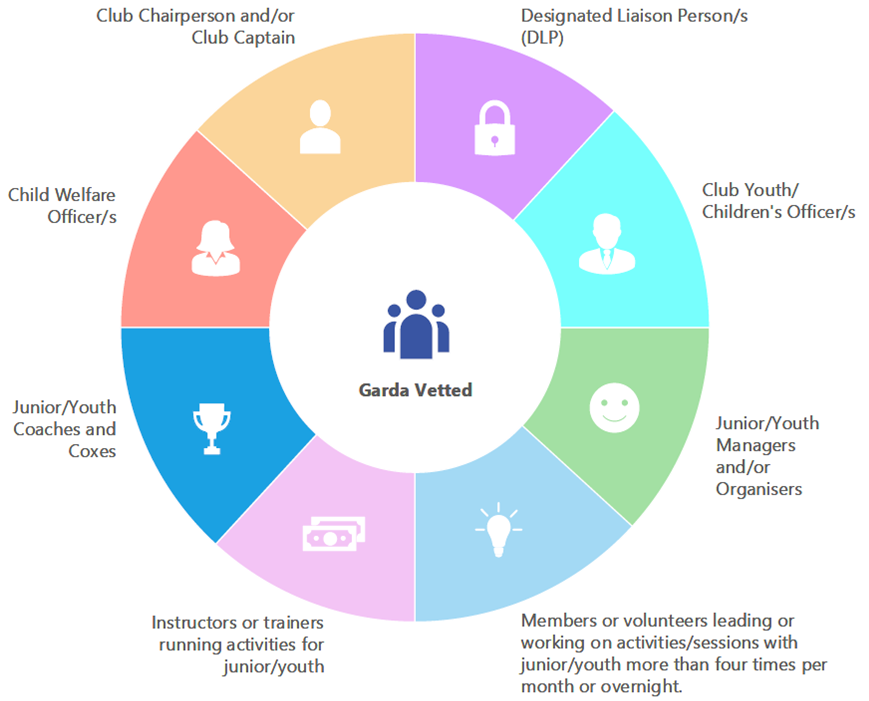
As a guide, people in the following positions within ICRF-affiliated associations and clubs should be vetted, and a statement to that effect should be included as part of their respective Code of Ethics Policy.
- Club Chairperson and/or Club Captain
- Designated Liaison Person/s
- Club Junior/Youth/Children’s Officer/s
- Child Welfare Officer/s
- Junior/Youth Coaches and coxes
- Junior/Youth Managers and Organisers
- Instructors or trainers running activities or courses for children/youth or vulnerable persons.
- Members or volunteers leading or working on activities or sessions where they will have contact with junior/youth or vulnerable persons more than four times in any month, or overnight.
Who should be Garda Vetted?
Roles to consider . . . . .
Vetting for persons 18 years and over
- Each applicant must print out and then complete the NVB1 Form.
- The name of the organisation is the Irish Coastal Rowing Federation.
- Please be clear when identifying the role you are applying for. Your role description must include reference to youth/juniors (E.g. Coach for junior/youth crews -will be accepted. Coach will not be accepted.)
- Each applicant must provide two forms of identification (ID). Please use the 100 Point ID Check form to identify the appropriate documentation. The two forms of ID must be a minimum of 100 points to be accepted.
- One must contain photographic identification.
- One must contain the applicant’s current address. If using a utility bill, for example, it must be dated within the last six months.
Applicants are requested to photocopy the 2 forms of ID that will be used for the application and submit the photocopies with the NVB1 form. Applicants MUST bring the 2 original forms of ID with them on the day when they meet with the Child Safety Officer for their Garda Vetting Application. The originals must be sighted on the day or the application cannot proceed.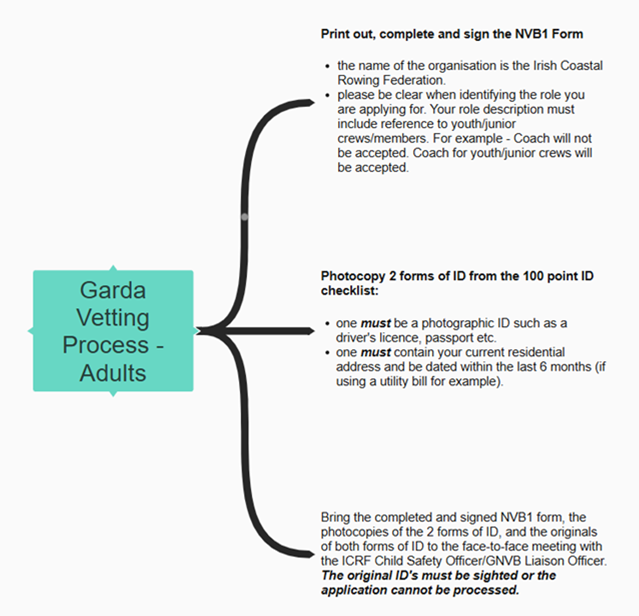
Vetting for persons under 18 years of age
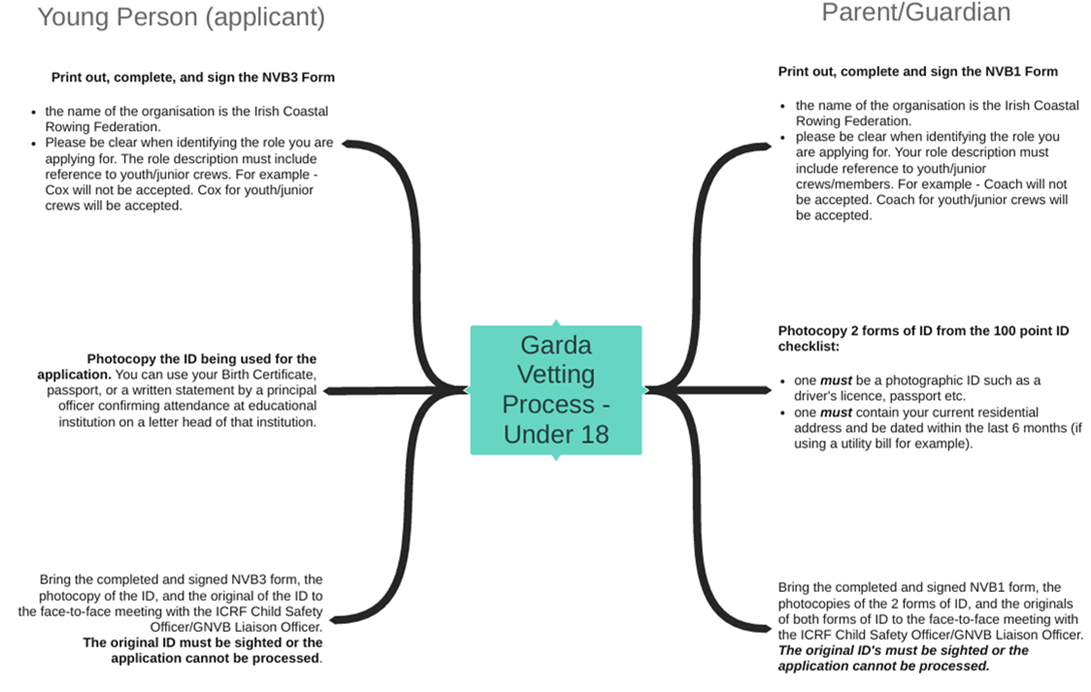
- Each applicant (under 18) must print out and then complete the NVB1 Form.
- The name of the organisation is the Irish Coastal Rowing Federation.
- Please be clear when identifying the role you are applying for. Your role description must include reference to youth/juniors (E.g. Coach for junior/youth crews -will be accepted. Coach will not be accepted.)
- Each applicant (under 18) must provide one of the following as a form of identification (ID).
- Birth Certificate
- Passport
- Written statement by a principal officer confirming attendance at educational institution on a letter head of that institution
- The parent(s)/guardian(s) of the young person must print out and complete the NVB3 Form.
- The name of the organisation is the Irish Coastal Rowing Federation.
- Please be clear when identifying the role you are applying for. Your role description must include reference to youth/juniors (E.g. Coach for junior/youth crews -will be accepted. Coach will not be accepted.)
- The parent/guardian must provide two forms of identification (ID). Please use the 100 Point ID Check form to identify the appropriate documentation. The two forms of ID must be a minimum of 100 points to be accepted.
- One must contain photographic identification.
- One must contain the applicant’s current address. If using a utility bill, for example, it must be dated within the last six months.
Applicants and parent/guardian(s) are requested to photocopy all ID’s being used for the application and submit the photocopies with the NVB1 and NVB3 forms. Applicants and parent/guardian(s) MUST bring the 3 original forms of ID with them on the day when they meet with the Child Safety Officer for their Garda Vetting Application. The originals must be sighted on the day or the application cannot proceed.
The cost of each vetting application is €10 and is payable to the ICRF upon submission of the NVB1 Form and ID documentation.
- Payment of the €10 should be made to the ICRF by electronic funds transfer (EFT) to the following:
-
- Pay to: Irish Coastal Rowing Federation,
- BIC: AIBKIE2D
- IBAN: IE78AIBK93432101761099
- Please state the purpose of the payment, ie, Garda Vetting payment, your Name and your Club.
-
How is vetting carried out?
- The applicant completes the appropriate NVB1 or NVB 3 Garda Vetting Form.
- The applicant identifies identification using the 100 Point ID Check.
- Face-to-face meeting is scheduled with the ICRF Child Safety Officer/GNVB Liaison Officer for the Garda Vetting applications.
- On the date of the meeting the applicant must bring the completed NVB1 form along with the photocopies of the 2 forms of ID being used, as well as the 2 original forms of ID (originals must be sighted).
- Following a successful face-to-face meeting, the ICRF Child Protection Officer/GNVB Liaison Officer will send a confirmation email from gardavetting@coastalrowing.ie to confirm the email address provided on the NVB1 Form.
- The ICRF Child Protection Officer/GNVB Liaison Officer will then submit the NVB1 (NVB3 for a young person) Application to the Vetting Agent (Wicklow Volunteer Centre).
- The Vetting Agent checks the information and then submits the NVB1/NVB3 Form to the Garda National Vetting Bureau (GNVB).
- The GNVB will email the applicant a pin number which is required to log in and complete the NVB2 Form online.
- Applicants have 30 days, including the date the email is received, to complete the NVB2 Form online.
- The NVB2 Form is submitted to the Wicklow Volunteer Centre for processing. It is vitally important that you provide all address information on the NVB2 Form.
- If the NVB2 Form is correct, it will be submitted to the GNVB for final processing.
- If the form is incorrect, it will be cancelled and a new NVB2 Form will be sent to the applicant. An additional €10 fee will be charged.
- Vetting results are called a disclosure regardless of the outcome.
- Disclosures relating to a Conviction or Specified Information or a note, will be emailed directly to the applicant who will have 15 days to query this directly with the GNVB.
- The final outcome/disclosure is emailed to the ICRF Child Protection Officer/GNVB Liaison Officer who will inform the applicant of the disclosure.
- The ICRF will not send the results of a vetting disclosure to anyone except the applicant.
Attached below are a number of revised documents: